
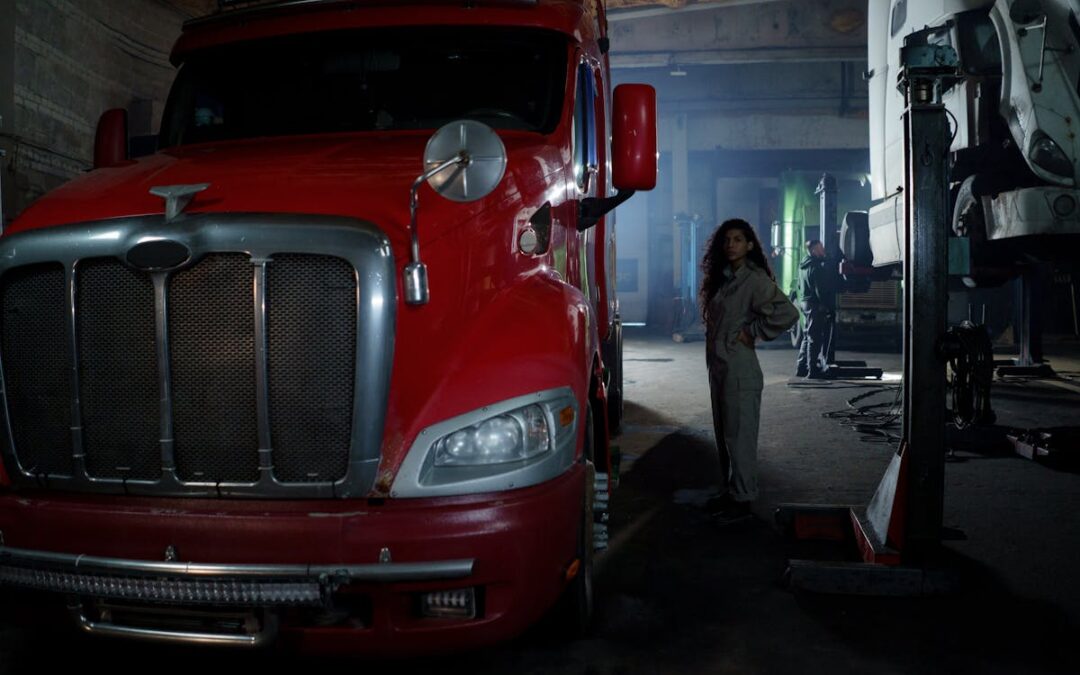
There’s a specific feeling that hits when a truck starts acting up on the highway. Maybe it’s a dashboard light you’ve never seen before, or a knock under the hood that wasn’t there yesterday, or the whole rig just starts losing power with nowhere good to pull off. Your stomach drops. You start doing the math on delivery times, and somewhere behind that, there’s a quieter worry about getting off the road safely.
If you’ve been driving long enough, a breakdown eventually happens to everyone. It doesn’t matter how well you maintain your equipment. Hoses fail, alternators die, tires blow, and sometimes things go wrong at the worst possible moment. What actually matters is what you do in the twenty minutes after it happens, because that window determines whether this turns into a manageable inconvenience or a genuinely dangerous situation.
Here’s what to do, step by step, before your mobile mechanic shows up.
Get Off the Road Completely If You Can
#image_title
This sounds obvious, but panic makes people do strange things, so it’s worth saying clearly. If your truck is still drivable at all, get as far onto the shoulder as possible. Not just “mostly off the lane,” but as far right as the terrain allows, ideally past the rumble strip if there is one.
If you’re losing power gradually rather than all at once, use whatever momentum you have left to coast toward an exit ramp, a wide shoulder, or a truck stop rather than stopping dead in a travel lane. A few hundred extra feet of coasting can be the difference between being tucked safely off the highway and being a hazard that other drivers are swerving around at 70 miles an hour.
If the truck dies completely and you can’t move it, don’t try to push it or force it. Your safety matters more than the vehicle’s position at that point.
Turn on Your Hazards Immediately
The second your truck starts acting up, even before you’re sure it’s a full breakdown, hit the hazard lights. Don’t wait until you’ve stopped completely. Other drivers need as much warning as possible that something’s wrong up ahead, especially at highway speeds where reaction time is everything.
Keep them on for the entire time you’re stopped, but the timing of when you turn them on matters more than most people realize. Early warning gives approaching traffic time to change lanes calmly instead of making a last-second swerve.
Set Out Reflective Triangles or Flares
If you’re carrying emergency triangles, and you should be since they’re required equipment for commercial vehicles, get them out and placed as soon as it’s safe to do so. The general guidance is to place one about 10 feet behind your vehicle, another around 100 feet back, and a third further back still, especially on a curve or hill where visibility is limited.
This matters more at night, in bad weather, or on roads with limited sightlines, but it matters every time. A stopped truck on a highway shoulder is genuinely hard to see until it’s suddenly very close, and those few extra seconds of warning for oncoming traffic are what prevent secondary accidents, which are statistically one of the more common ways breakdown situations turn dangerous.
Get Out on the Safe Side, or Stay In If Necessary
If your truck is positioned close to live traffic, exit from the passenger side whenever possible. Standing on the traffic side of your vehicle, even briefly, puts you at real risk, especially on a highway where vehicles are moving fast and drivers may not see you until they’re right on top of you.
If you genuinely can’t get out safely, it may actually be safer to stay buckled in the cab rather than stand outside next to traffic. Use your judgment based on the specific situation, but always default to whichever option keeps you furthest from moving vehicles.
Call for Help Before You Do Anything Else
#image_title
Once you and your vehicle are as safe as you can make them, make the call. If you’re working with a 24/7 mobile repair service, get them on the phone now, because the sooner they know your situation, the sooner someone’s heading your way.
Be ready to give clear, specific information:
- Your exact location: mile marker, nearest exit, direction of travel, GPS coordinates if you have them
- What the truck is doing in plain language: losing power, won’t start, strange noise, warning light, etc.
- Whether you’re fully off the road or still partially in a lane
- Whether you’re hauling a load and if it needs any special handling
The more specific you can be, the faster a mechanic can diagnose the likely issue before they even arrive, which often means they show up with the right parts already in hand instead of needing to make a second trip.
Note What Happened While It’s Fresh
While you’re waiting, take a few minutes to think through what led up to the breakdown. Was there a warning light before it happened? Any unusual noise, smell, or vibration in the minutes leading up to it? Did it come on slowly or hit all at once?
This kind of detail fades quickly once the adrenaline wears off. Jotting it down while you wait can genuinely speed up the diagnostic process when help arrives. A mobile mechanic walking up to a truck with zero context has to start from scratch. A mechanic who already knows “it started sputtering around 3,000 RPM before it died” has a real head start.
Check on Your Load If You’re Hauling One
If you’re carrying freight, especially anything temperature-sensitive or time-critical, check its status and get in touch with dispatch or your carrier to flag the situation. Nobody likes making that call, but the earlier you report the delay, the more options everyone downstream has to adjust.
If you’re hauling something that needs to stay cold or otherwise controlled, keep an eye on how long the reefer unit can run safely if the tractor itself is down.
Stay Visible and Stay Patient
Once everything is set up, hazards on, triangles out, help called, notes taken, the hardest part is just waiting. It’s tempting to pace around, check under the hood, or try to troubleshoot things you’re not totally sure about. Resist that urge unless you genuinely know what you’re doing mechanically. Poking around a problem you’re not certain about can make things worse, or put you standing near traffic longer than necessary.
Stay as visible as possible, stay off to the side and away from the road, and let the person you called do their job when they arrive.
The Bottom Line
Breakdowns are stressful by nature, but the real danger in most highway breakdown situations doesn’t come from the mechanical failure itself. It comes from what happens in the minutes right after, when visibility and positioning matter more than anything else. Get off the road as far as you can, warn other drivers early and clearly, protect yourself from traffic, and give whoever’s coming to help the specific information they need to do their job.
Battle Ready Roadside LLC provides 24/7 mobile tractor and trailer repairs. Call or text 623-755-1196.
